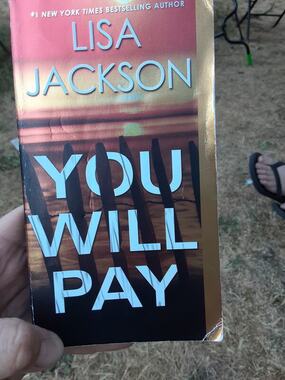
 "You Will Pay"?
Yes I did. Before you keep reading: If you want a synopsis or 6th grade book report, read the other reviews. They all follow the same formula: "Here's what the book is about. Gush on this character. Approval!" I'm writing more for the people who want to be warned off or encouraged to read based on shared requirements. Some of my requirements for a book: 1) The events move the character or story forward. 2) The authors political or religious bias do not decide who the "bad guy" is (unless it is clearly stated as a religious/political fiction). 3) No Deus Ex Machina. I do not recommend this book. This "mystery" is easy to solve if you hate Christians, and the sub mysteries aren't even allowed to be solved by you, the reader. It's pretty crappy when you have over 150 pages left in a murder mystery and the killer literally "outs" themselves effectively ending the majority of the novel. The rest is just a played out explanation with two dimensional characters about how they did, did not, or were going to kill someone. I paid dearly for this novel, with every chapter a tedious dragging of cliché. Non spoiler spoilers: Do you hate Christians? Do you like soap operas? Do you like double hypocrisy charading as moral integrity? Do you like reading about teenage sex and sexual abuse? Do you like repetitive chapters that flip flop back and forth through time for no discernable reason that interrupts narrative flow? Do you love the old Scooby Doo mysteries where it turns out its Old Man Smithers who wants the title to the old amusement park back? So what we have here is a murder mystery that you can't solve by clues alone, but you can solve if you know the bias of the author. Got that? Going into this book I had no idea who the author was (or other books by her). From the first two hook chapters (that is being generous) it's obvious that Christians are bad people*, and working from that viewpoint the rest of the mystery and motivations become clarified. Easily. Anyone who claims to believe is automatically abusive or lying, only the non believers have moral superiority (even when they have sex with their step mom. That's not a spoiler), and sexual purity concepts, cheating and infidelity are bad unless you're gay or brainwashed. Even then, it's only bad when Christians cheat on their spouses because, you know, they're bad. Mmkay. Christians are bad, mmmkay. If you are a Christian, you're bad, mmkay? Did she mention Christians are bad? When you know from the start who the bad guys are, it makes solving a murder mystery simple. From there it's all cliché; overbearing money grubbing wife cheating Reverend. Cheating attention seeking Reverends wife. Reverends kids who are narcissists at best. Christian Councilors who don't care about anything except who is sleeping with who. Revenge for who slept with who. And this is told ad nauseum! The back and forth between "Now" and "Then" is so tedious! Sorry Miss Jackson! Whooo! I am for real: never take two chapters to explain the same thing. If you first person explain a "then" event for a chapter, don't take up the second chapter telling the same event from the same character "Now" as they remember the events in "Then". OKAY! It is NOT clever. Especially when you pretty much write from the viewpoint of all the characters....except the guilty ones. It was practically a lie by omission. (I was hoping against hope that one character would turn out to be the murderer in a long bid for self aggrandizement, but it was not to be. That would have been truly clever, in the keeping of Vidocq or even a Father Brown mystery, which would have fit nicely, but just ended up being my aforementioned Scooby Doo ending.) Throw in a Deus Ex Machina involving a YouTube video, and we have all the seasonings for this novel. I want to slap the editor with the red pen they should have used to cut this 500 page book down to it's required 290 pages. I've heard it said that "It's not the destination, it's the journey", but anyone who has watched Game of Thrones knows that the journey is wasted if you spent too long getting to your destination, only to have it end in a ridiculous revenge overkill in a pat ending. SPOILER: The bad guys die in a ludicrous and convenient way, hoisted by their own petard. And I mean that in every reference to Hamlet; The phrase's meaning is literally that the bomb-maker (a "petard", a small explosive device) is blown up ("hoisted" off the ground) by his own bomb, and indicates an ironic reversal, or poetic justice. This actually happens. SPOILER: There is also maybe a ghost. There is a reveal of the ghost that may or may not be a ghost, which ended up being completely Scooby Doo Saturday Morning fodder. I will give credit for the use of modern technology in avoiding the whole "why don't they just call the police". It was refreshing to read that. This isn't the worst thing I've ever read. That was Pretending the Bed Is a Raft by Nanci Kincaid, where I wanted all the characters to die. So I would read You Will Pay over that, but barely.
0 Comments
Leave a Reply. |
AuthorWrite something about yourself. No need to be fancy, just an overview. Archives
August 2021
Categories |
 RSS Feed
